Blog · History · Anthropology
The power of storytelling: how stories carried us through history
Long before books, people kept their history alive by telling it. This is the story of how stories travelled across generations, and why they matter more than ever.
Imagine a night thousands of years ago. The work of the day is done. A fire crackles, children lean against their parents, and an old woman begins to speak. She tells how the river once flooded, which plants heal and which kill, and how their ancestors crossed the mountains.
Nobody writes anything down. Yet the knowledge survives, because the children will tell it to their own children, and they to theirs.
For almost all of human history, this is how we remembered. This article follows that thread, from fires and cave walls to chants, writing, codes and printing presses, and asks what happens to it now.
Around the fire
Anthropologist Polly Wiessner spent years listening to the Ju/’hoansi, hunter-gatherers in Botswana and Namibia. In a 2014 study, she compared what people talked about by day and by night.
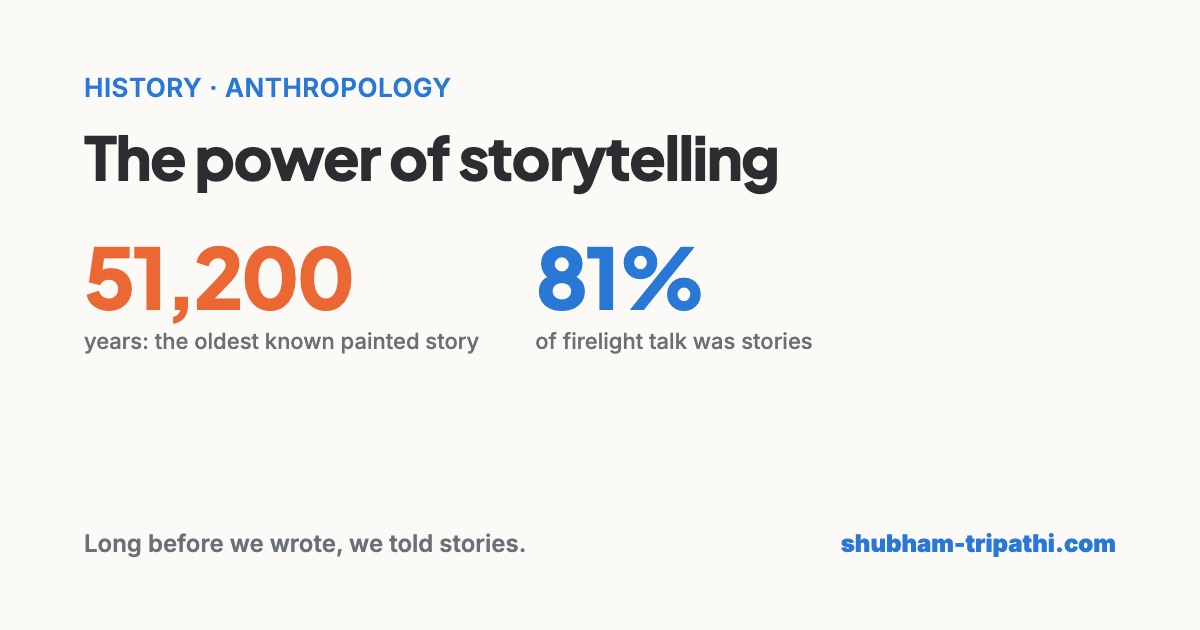
The difference was striking. During the day, conversation was mostly practical: complaints, criticism and work. At night, around the fire, 81% of long conversations were stories.

Wiessner argues that firelight stories did something daytime talk could not. They helped people understand each other’s minds, remember distant relatives and share the bigger picture of their culture. Long before buildings or books, the campfire was a school, a library and a family album.
Stories on cave walls
Spoken stories vanish into the air, so we cannot know when the first one was told. But some people also painted them.
In 2024, researchers dated a painting in Leang Karampuang cave, on the Indonesian island of Sulawesi. It shows three human-like figures interacting with a wild pig, and it is at least 51,200 years old. The team describes it as the oldest known picture story. They also suspect storytelling is far older still.
Much later, around 17,000 years ago, people at Lascaux in France covered cave walls with horses, bulls and deer. We will never hear the words spoken in front of those paintings, but we can feel the urge behind them: to show others what mattered.

Memory as a library
Without writing, the human mind was the library. People developed remarkable ways to keep long stories accurate across generations.
The singers of the Balkans
In the 1930s, scholars Milman Parry and Albert Lord travelled through Yugoslavia, recording singers who performed epic poems from memory. The greatest, Avdo Međedović, sang one epic of about 13,000 lines over several days, close to the length of Homer’s Iliad. Lord’s 1960 book, The Singer of Tales, showed how such poets build each performance from familiar phrases and patterns. Their work changed how scholars think Homer’s epics were first made.
Vedic chanting in India
The Vedas, among the oldest texts in India, were passed down by voice for around 3,000 years. Students learned them through recitation patterns that repeat words forwards, backwards and in pairs, so that not a single syllable changes. UNESCO recognised the tradition as part of humanity’s intangible heritage in 2003.
The griots of West Africa
In West Africa, griots are hereditary keepers of memory. They hold family histories, praise songs and the epic of Sundiata, founder of the Mali Empire in the 13th century. In Niagassola, Guinea, one griot family still guards the Sosso-Bala, a balafon said to date from that time.
Memories of the rising sea
Some researchers believe oral stories can last far longer. Patrick Nunn and Nicholas Reid studied Aboriginal Australian stories from 21 coastal places that describe land being swallowed by the sea. They argue these may remember real sea-level rise from 7,000 or more years ago. Others point out that an unbroken chain of telling cannot be proven, so the claim remains debated. Even so, it is a breathtaking idea.
When stories learned to wait
Around 5,200 years ago, in Sumer, people began pressing marks into clay. The first writing was not poetry. It recorded grain, livestock and labour.
Soon, though, writing began to hold stories too. The Epic of Gilgamesh, about a king who searches for a way to escape death, is one of the oldest written stories, with copies surviving from nearly 4,000 years ago. For the first time, a story could wait silently for a reader long after its teller had died.
Scholar Walter Ong argued in Orality and Literacy (1982) that writing changed not only how we store knowledge but how we think. Stories no longer had to live in someone’s memory. They could live on a page.
Stories in code
Some stories were meant only for certain eyes. The Roman historian Suetonius records that Julius Caesar wrote private messages by shifting each letter three places along the alphabet.
Others were hidden by time rather than intent. Egyptian hieroglyphs could not be read for centuries, until Jean-François Champollion used the Rosetta Stone to decode them in 1822, and the voices of ancient Egypt spoke again.
The search still goes on. In 2023, codebreakers deciphered 57 secret letters written by Mary, Queen of Scots, during her imprisonment. Historian John Guy called it the most important new find about her in a century. Even in code, people were telling their story, hoping someone would one day understand.
Stories for everyone
In the 1450s, Johannes Gutenberg’s printing press in Mainz made it possible to copy books quickly and cheaply. Historian Elizabeth Eisenstein argued that printing helped fuel the Renaissance, the Reformation and the Scientific Revolution, because the same ideas could reach thousands of readers at once.
Later came radio, recordings and film. Each new tool carried stories further. Yet each one also moved them a little further from the fire, from a voice speaking to people who could answer back.
Why stories matter
Why have humans clung to stories through every change? Scholars give several answers that fit together:
- Stories help us practise life. Writer Jonathan Gottschall, in The Storytelling Animal (2012), compares stories to a flight simulator for social problems.
- Stories sharpen our minds. Literary scholar Brian Boyd, in On the Origin of Stories (2009), argues that fiction is a kind of mental play that improves how we understand others.
- Stories let strangers cooperate. Historian Yuval Noah Harari argues in Sapiens that shared stories, such as myths, nations and money, are what let millions of strangers work together.
Underneath all three is something simpler. A story is how one person says to another: this happened, it mattered, remember it.
Is the fire going out?
Today we have more stories at our fingertips than any generation before us. Yet some of the old ways are fading.
A 2025 study of more than 236,000 Americans found that the share who read for pleasure on a given day fell from about 28% in 2004 to 16% in 2023, a drop of about 40%. And UNESCO estimates that, on average, a language disappears every couple of weeks. When a language dies, the stories, songs and knowledge carried inside it often die too.

You may have heard that our attention span is now shorter than a goldfish’s. That claim is a myth, traced to a marketing report rather than research. The real change is quieter. Our attention is pulled in many directions at once, and much of what we take in is short, fast and quickly forgotten. Fewer evenings end with someone saying, “Let me tell you about the time…”
Perhaps this is the moment to remember what the fire taught us. Stories are not just entertainment. They are how we know who we are, where we came from and what we owe each other. Ask an older relative to tell you about their childhood. Read a long book slowly. Tell your children the stories you were told.
The fire has burned for at least fifty thousand years. Whether it keeps burning depends, as it always has, on the next person willing to listen, and then to tell.
Frequently asked questions
Why is storytelling important in human history?
Before writing, stories were the main way people passed on knowledge, values and history. They carried practical lessons, explained the world and bound groups together, and they still shape how we remember and decide.
What is the oldest known story?
The oldest known picture story is a cave painting at Leang Karampuang in Sulawesi, Indonesia, showing human-like figures with a wild pig. It is at least 51,200 years old. Spoken stories are almost certainly older, but they leave no trace.
How did people pass down stories before writing?
They memorised and performed them. Poets used repeated phrases and rhythms, Vedic priests used chanting patterns that check every syllable, and West African griots trained for years to recite family histories and epics.
Can oral history really last thousands of years?
Some researchers think so. Aboriginal Australian stories from 21 coastal places describe land being lost to the sea, which may match sea-level rise 7,000 or more years ago. The idea is debated, because an unbroken chain of telling cannot be proven.
Is storytelling declining today?
Some forms are. The share of Americans who read for pleasure on a given day fell from about 28% in 2004 to 16% in 2023. UNESCO also warns that languages, and the oral traditions inside them, are disappearing.
Is it true that our attention span is now shorter than a goldfish’s?
No. That claim came from a marketing report, not research, and psychologists do not measure a single average attention span. The real concern is how much of our attention goes to fast, fragmented content.
Sources
- Oktaviana, A. A. et al. (2024). Narrative cave art in Indonesia by 51,200 years ago. Nature 631.
- Wiessner, P. (2014). Embers of society: Firelight talk among the Ju/’hoansi Bushmen. PNAS 111(39).
- Lord, A. B. (1960). The Singer of Tales. Harvard University Press. See also the Center for Hellenic Studies on Avdo Međedović.
- Nunn, P. and Reid, N. (2016). Aboriginal memories of inundation of the Australian coast dating from more than 7000 years ago. Australian Geographer 47(1). Summary in Science News.
- UNESCO. Tradition of Vedic chanting and Cultural space of Sosso-Bala.
- Ong, W. J. (1982). Orality and Literacy: The Technologizing of the Word. Methuen.
- Eisenstein, E. (1979). The Printing Press as an Agent of Change. Cambridge University Press.
- Lasry, G., Biermann, N. and Tomokiyo, S. (2023). Deciphering Mary Stuart’s lost letters. Cryptologia. Summary in Scientific American.
- Gottschall, J. (2012). The Storytelling Animal. Boyd, B. (2009). On the Origin of Stories. Harari, Y. N. (2014). Sapiens.
- Bone, J. et al. (2025). Reading for pleasure in the United States, 2003–2023. iScience. Summary from UCL.
- UN News (2018). International Mother Language Day. BBC (2017). Busting the attention span myth.